



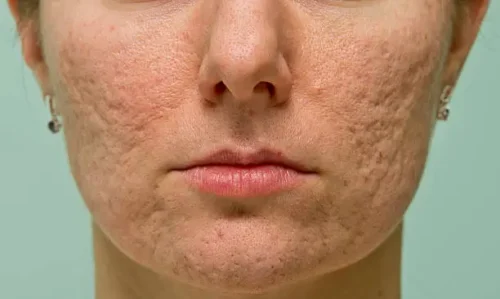
Nearly half of people with acne go on to develop some scarring, according to a large meta-analysis of over 24,000 patients. For many adults, acne itself remains persistent, too. Are you still hiding acne scars long after your breakouts ended? You’ve tried covering them up for years. It’s time to treat them instead. These 4 in-office treatments go beyond skincare. They rebuild collagen and smooth your skin.
Your Breakouts May Be Over, but the Scars Are Still There
These marks may have lingered since your teenage years, and you’re still trying to cover them up. You’ve likely explored scar creams and brightening products. But these persistent acne scars don’t go away. Looking at them in the mirror every morning can be discouraging. It’s normal to feel frustrated after putting in so much effort for so long.
The lack of results happens because acne scars are not a surface problem; they form deeper in the skin.
If your acne is still active, that comes first. Your provider will treat breakouts before starting scar treatment, since new inflammation can affect results. Once acne is under control, scar treatment can begin.
Why Skincare Products Can’t Fix Acne Scars
Acne scars develop in the dermis, the deeper layer of skin that produces collagen. Collagen is what keeps skin firm and smooth. When a deep pimple heals, it can destroy collagen, leaving a dent in the skin or dark marks behind. Skincare products only work on the top layer of skin, the epidermis, so even a strong retinol or vitamin C serum can’t rebuild collagen that was lost years ago.
Understanding why skincare falls short helps highlight the importance of professional intervention. Professional treatments work differently: they don’t just try to fade the scar from the outside; they trigger your skin to rebuild the collagen it lost. Your skin already knows how to make collagen and clear dark marks; it just needs the right signal. In-office treatments deliver that signal through controlled micro-injury, focused light, or laser energy, prompting the skin to repair itself from the inside.
Matching Scar Type to Treatment
Not all acne scars are the same, and the right treatment depends on which type you have.
| Scar Type | What It Looks Like | Best-Suited Treatment |
| Ice pick | Narrow, deep, pinpoint scars | Laser Skin Resurfacing, Laser Scar & Stretchmark Removal |
| Boxcar | Broad depressions with defined edges | Firming & Texture Renewal, Laser Resurfacing |
| Rolling | Shallow, wave-like depressions | Firming & Texture Renewal (Microneedling) |
| Post-acne discoloration (red or brown marks, no indentation) | Flat, but discolored | IPL photofacial |
Ice pick scars go deep into the skin, so they respond best to treatments that reach further below the surface, like resurfacing and targeted laser energy.
Boxcar scars have sharp, defined edges. Microneedling and resurfacing help soften those edges by rebuilding collagen beneath the skin.
Rolling scars are shallow and uneven, not deep. Microneedling works well here because it smooths texture without needing to reach as far into the skin.
Post-acne discoloration isn’t textural at all; it’s just pigment. IPL treats color directly, without needing to disrupt skin structure.
Many have multiple scar types, making a personalized consultation essential for effective treatment.
The 4 Treatments: Sessions & Downtime at a Glance
| Treatment | How It Works | Typical Sessions | Downtime |
| Firming & Texture Renewal (Microneedling) | Micro-channels trigger new collagen and elastin | 3–6 | 1–3 days (mild redness) |
| Laser skin Resurfacing | Removes damaged outer layers, boosts collagen underneath | 1–3, depending on depth | 3–10 days, depending on intensity |
| Laser Scar & Stretchmark Removal | Laser pulses break down scar tissue, stimulate new collagen | 3–6 | 2–5 days |
| IPL Photofacial | Light energy targets pigment and blood vessels | 3–5 | Little to no downtime |
Exact session count and downtime vary by individual skin and scar depth. Your provider will confirm your specific plan at the Consultation.

1. Firming & Texture Renewal Treatment (Microneedling)
Precise microneedling activates your skin’s natural collagen and elastin production. It’s a top choice for acne scars, uneven texture, and loose skin, and it’s safe across a wide range of skin tones when performed by an experienced provider. Expect firmer, smoother-feeling skin and a noticeable reduction in the depth of rolling and boxcar scars over a series of sessions.
2. Laser Skin Resurfacing
Laser resurfacing removes damaged outer layers of skin while stimulating new collagen production beneath the skin. It’s one of the most effective treatments for improving overall texture, especially scarring that has resisted other approaches. Patients typically see tighter, more even-textured skin and softened scar edges, with results that continue improving as new collagen builds.


3. Laser Scar & Stretchmark Removal
Using targeted pulses of laser energy, this treatment breaks down scar tissue directly and stimulates fresh collagen production. Skin becomes smoother, softer, and more even over a series of sessions. Most patients notice shallower-looking scars and a more uniform skin surface, particularly for deeper ice pick or boxcar scarring.
4. IPL Photofacial
Not every scar is a dent. IPL targets the red and brown marks acne leaves behind, using light energy to fade discoloration at the source, with little to no downtime. Expect reduced redness and brown discoloration, along with a brighter, more even skin tone after a full series. It works best for post-acne discoloration and can help refresh skin tone when pigment is the main concern.

For patients who need more than one concern addressed, combination treatments often deliver the most complete results. Radiant Glo pairs an IPL Photofacial with Skin Rejuvenation to target pigment and texture together. Dynamic Duo combines Skin Rejuvenation with Laser Resurfacing for more dramatic improvement in tone and texture, a genuine option worth asking about if you’re dealing with more than one type of scarring.
Ready to find out which treatment fits your skin? Book a free consultation and get a personalized plan before you decide on anything.
What Results Should You Expect?
Most patients see the best results from a series of sessions, spaced a few weeks apart.
- After the first session, skin looks fresher, and discoloration begins to soften.
- After two to three sessions, texture visibly smooths, and scars appear shallower.
- Three to six months in, you’ll see the biggest change, as new collagen fully matures.
Deep scars soften dramatically. Shallow scars and discoloration can improve to the point of being barely noticeable. Combination treatments, like pairing IPL with resurfacing, tend to deliver the most visible transformation.
Who Are the Best Candidates
You are likely a strong candidate if:
- Your acne is no longer active or well controlled.
- You have textural scars or uneven skin that creams haven’t touched.
- You have red or brown post-acne marks that won’t fade.
- You want gradual, natural-looking improvement without surgery.
These treatments are not a substitute for active acne care, and results depend on scar depth and skin type. A consultation confirms your scar type and skin tone, then matches you with the right treatment or combination.
Conclusion: Stop Covering. Start Correcting.
You’ve spent years perfecting the art of hiding your scars: good lighting, the right angle, a little extra concealer. Here’s the better plan: treat the scar once, instead of covering it every morning.
Adult acne scars are a structural problem, and structure can be rebuilt. Microneedling, laser resurfacing, scar removal, and IPL reach the layer of skin where your scars actually live, doing what no product ever could.
Ready to see your skin without the scars? Request your free consultation at Beautiful Eyes Aesthetics and Wellness in Greenfield, MA, and get a treatment plan built for your skin.
Frequently Asked Questions
1. Why don’t skincare products fix acne scars?
Skincare only works on the surface. It can’t rebuild collagen that’s already gone. Real repair has to start much deeper. That’s why creams alone were never enough.
2. How many treatments will I need to see results?
Most people need 3 to 6 sessions. New collagen takes several weeks to form, which is why results build up gradually. Spacing sessions out helps your skin heal between treatments.
3. Can these treatments improve scars that have been present for years?
Yes, the depth and type of scarring matter more than how old it is. These treatments target the dermis directly, where the scar tissue actually formed. A consultation will confirm whether your specific scars are a good candidate.
4. Are these treatments safe for all skin tones?
Yes, when settings are adjusted by an experienced provider. Some laser treatments carry a higher risk of temporary pigment changes in deeper skin tones, which is exactly why a personalized consultation comes before any treatment plan.
5. What’s the downtime after treatment?
Most people see mild redness or swelling for a day or two, and many return to normal activities the same day. Sun protection matters most after every session. Your provider will walk you through specific aftercare.
6. How long do the results last, and will maintenance treatments be needed?
Results often last a year or more. Aging and sun exposure affect skin over time, so many patients add a maintenance session once or twice a year.
7. What does treatment cost?
Cost depends on the treatment, number of sessions, and whether you combine treatments. A consultation will give you an accurate, personalized quote.
8. Should I choose microneedling or laser treatment?
It depends on your scar type. Microneedling works well for rolling scars and overall texture, while laser treatments are often better suited to deeper or more defined scars, such as ice pick or boxcar scars. Many patients benefit from a combination; your consultation will confirm the right approach.
Stop hiding your acne scars and start your journey to smoother skin today. Free consultation now! Book a visit with Beautiful Eyes Aesthetics and Wellness in Greenfield, MA.