


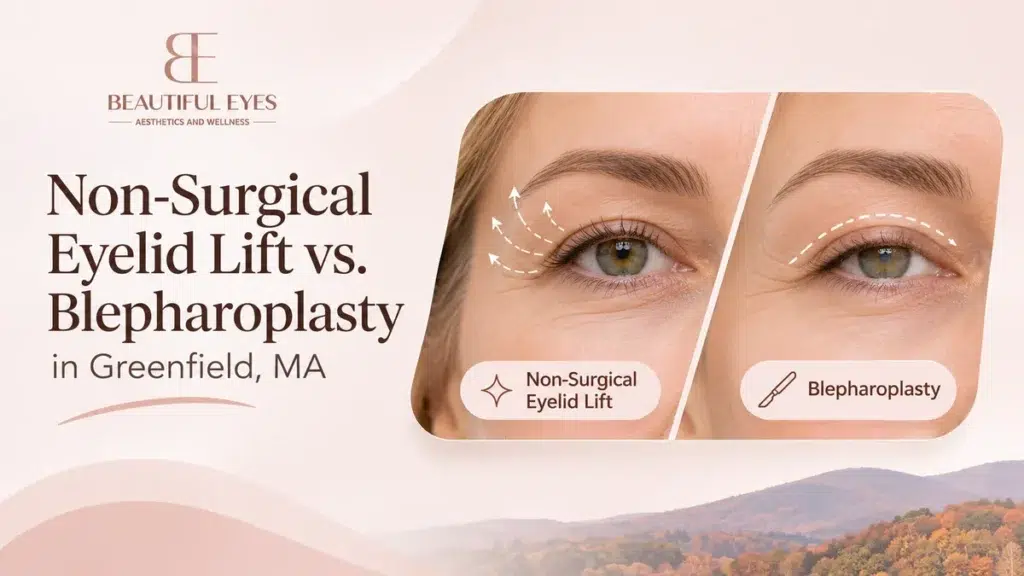
TL;DR: A non-surgical eyelid lift uses laser energy to smooth and tighten the skin around the eyes without incisions, while blepharoplasty is surgery that removes or repositions eyelid skin and fat. The non-surgical option suits mild to moderate laxity and builds results gradually. Surgery can correct more advanced sagging but involves anesthesia and a longer recovery. Beautiful Eyes Aesthetics and Wellness in Greenfield, MA helps you compare both, with eye health checked first.
Key Takeaways
- A non-surgical eyelid lift improves skin quality and mild laxity. It does not remove excess skin.
- Blepharoplasty removes or repositions tissue and suits more advanced sagging.
- Non-surgical results build over weeks to months, usually across a series of sessions.
- Both options carry risks, so an eye-health review comes first.
- Beautiful Eyes Aesthetics and Wellness is led by a board-certified ophthalmologist, and we tell you plainly if surgery is the better fit.
Comparing your options? Book a free consultation with our team in Greenfield.
In this guide:
- Why the eye area ages first
- What a non-surgical eyelid lift is
- Non-surgical vs. blepharoplasty
- Results and timeline
- Who is a good candidate
- Risks and who should wait
- What to ask at your consultation
- Eyelid care in Greenfield and Athol
- Bottom line
- FAQs
Why Does the Eye Area Show Aging First?
The skin around the eyes is thinner than most facial skin and has fewer oil glands, so fine lines and loose skin often appear here first. Years of squinting, sun exposure and genetics add up. That is why creams made for the whole face may not change this area much.
What Is a Non-Surgical Eyelid Lift?
A non-surgical eyelid lift is a laser treatment that resurfaces the top layer of skin around the eyes and gently heats deeper layers to encourage new collagen. The goal is smoother, firmer skin without incisions or stitches. Because it does not remove skin or fat, it works best for mild to moderate concerns.
At Beautiful Eyes Aesthetics and Wellness, the non-surgical eyelid lift uses Laser SmoothEye Rejuvenation and Resurfacing, planned under Medical Director Pierre R. Alfred, MD, a board-certified ophthalmologist. Learn more on our non-surgical eyelid lift page.
Non-Surgical Eyelid Lift vs. Blepharoplasty: What Is the Difference?
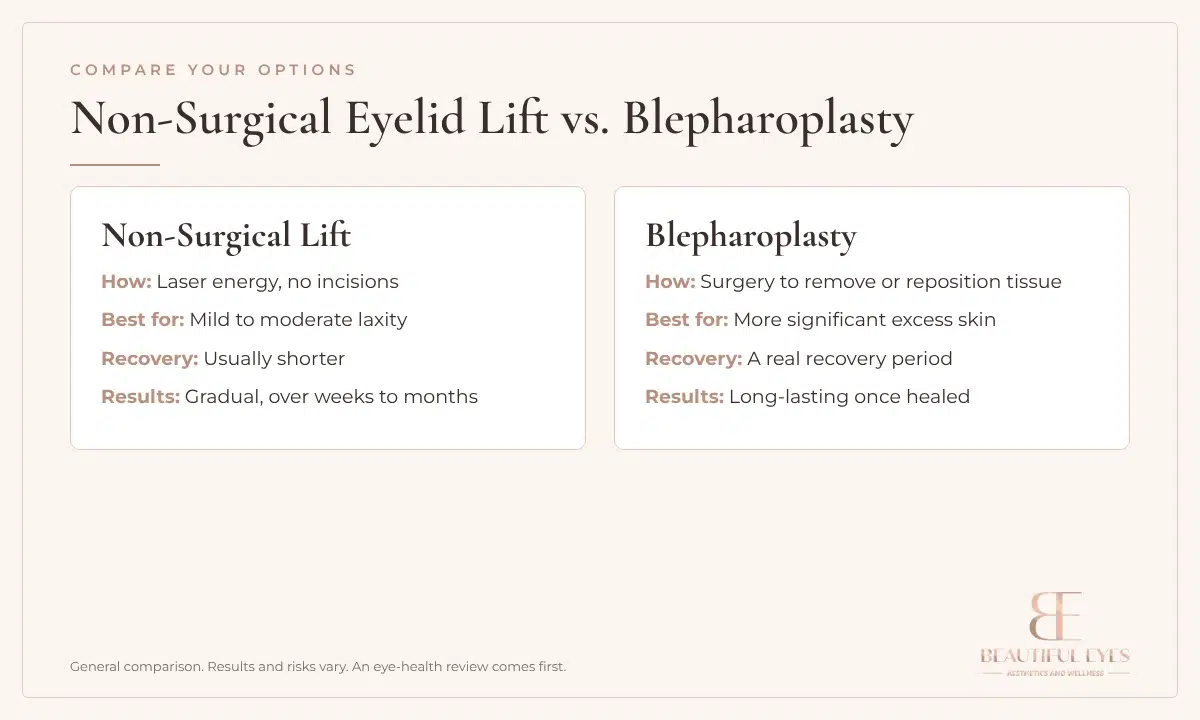
Blepharoplasty is eyelid surgery that removes or repositions skin, fat or muscle. A non-surgical eyelid lift improves skin quality and mild laxity without cutting. Surgery can change more, but it involves anesthesia, a recovery period and surgical risks. Neither option is right for everyone.
| Non-surgical eyelid lift | Blepharoplasty | |
|---|---|---|
| How it works | Laser energy, no incisions | Surgery to remove or reposition tissue |
| Best for | Mild to moderate laxity and fine lines | More significant excess skin or fat |
| Recovery | Usually shorter; redness and swelling can occur | A real recovery period after surgery |
| Results | Gradual, over weeks to months | Visible once healing settles; long-lasting |
| Sessions | Often a series | Usually one procedure |
| Main risks | Redness, swelling, pigment changes | Surgical risks, including rare vision changes |
The American Society of Plastic Surgeons lists the risks of eyelid surgery, including rare changes in vision. A board-certified surgeon can tell you whether surgery fits your eyes.
Not sure which path fits? Request a free consultation and we will walk you through both.
What Results and Timeline Can You Expect?
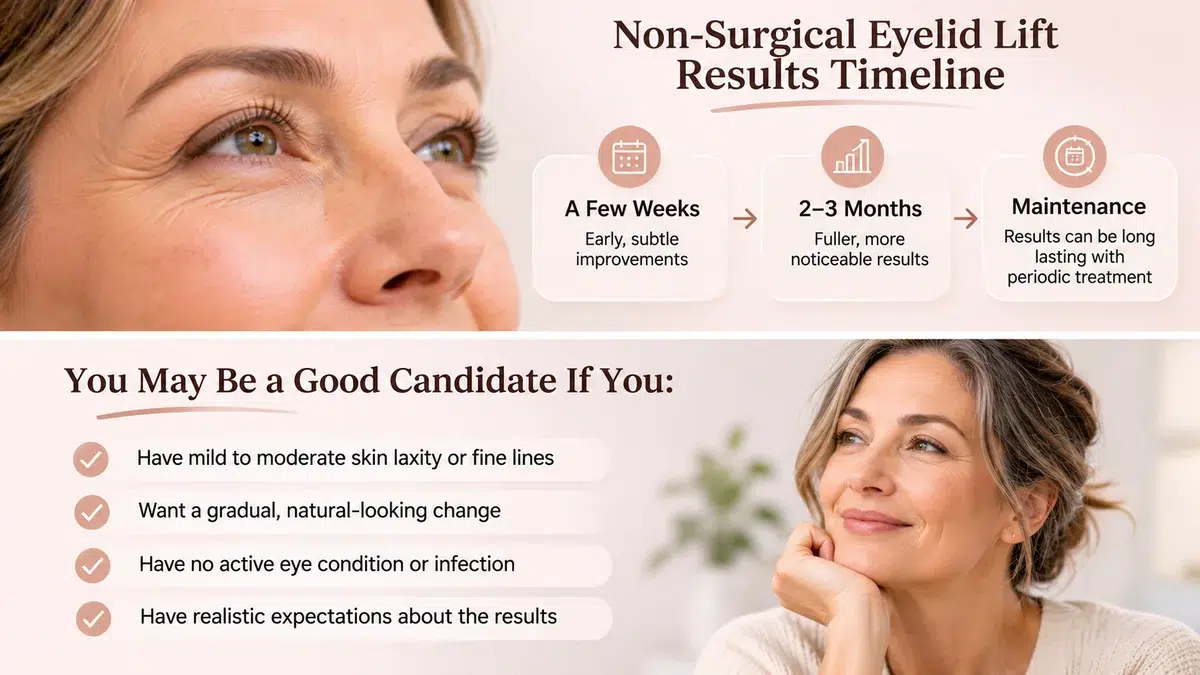
Results from a non-surgical eyelid lift build gradually. Many patients see subtle changes within a few weeks and fuller changes over two to three months, usually across a series of sessions. Your outcome depends on your skin, your concern and how you heal, and results vary.
Surgery gives a larger change once healing settles. According to the American Society of Plastic Surgeons, eyelid surgery results are long-lasting, but your skin keeps aging naturally afterward.
Who Is a Good Candidate for a Non-Surgical Eyelid Lift?
You may be a good candidate if you have mild to moderate loose skin or fine lines around the eyes, want a gradual change and have no untreated eye condition. If you have a lot of excess skin, or your lids block your vision, surgery or a medical evaluation may fit better.
- Mild to moderate skin laxity or fine lines
- Interest in a gradual, natural-looking change
- No active eye infection or inflammation
- Realistic expectations about what a non-surgical option can do
Risks, Side Effects and Who Should Wait
Laser treatment near the eyes is a medical procedure with real risks. Temporary redness, swelling, warmth and sensitivity are common. Less often, pigment changes, scarring or irritation can occur, so eye protection and screening come first.
Treatment may not be right if you have an active eye infection or inflammation, certain eyelid or eye conditions, recent eye surgery or a history of keloid scarring. Tell your provider about all medicines, including isotretinoin.
What Should You Ask at Your Consultation?
Ask how many sessions you are likely to need, what downtime to plan for, what the risks are and what change is realistic for your eyes. Also ask what would make surgery a better choice. A good consultation covers both paths honestly.
At Beautiful Eyes Aesthetics and Wellness, eye health is reviewed before any eyelid treatment is recommended, and we say so plainly if surgery is the better match. If you have concerns across the whole face, ask how eyelid treatment fits with our non-surgical facelift options.
Where Can You Get a Non-Surgical Eyelid Lift Near Greenfield, MA?
The non-surgical eyelid lift is offered at our Greenfield office, and free consultations are available in Greenfield and Athol. We welcome patients from Greenfield, Deerfield, Turners Falls, Bernardston and across Western Massachusetts.
- Greenfield (all services, including eyelid treatments): 33 Riddell Street, Suite 3 (Riddell Medical Building), Greenfield, MA 01301 · Get directions · View on Google
- Athol (consultations and medical-grade skincare): 184 Market Drive, Athol, MA 01331 · Get directions · View on Google
- Phone: 978-939-3128
- Hours (both offices): Monday to Friday, 8:00 am to 4:30 pm
Bottom Line: Which Option Is Right for You?
Choose a non-surgical eyelid lift if you have mild to moderate laxity and want gradual change without surgery. Consider blepharoplasty if you have significant excess skin or lids that affect your vision. Either way, start with an eye-health review and an honest conversation about what each option can do.
Ready to compare your options?
Prefer to talk? Call 978-939-3128. Free consultations are available in Greenfield and Athol.
FAQs About Non-Surgical Eyelid Lifts and Blepharoplasty
Q1. Will people notice I had something done?
Ans. The aim is a natural, rested look, and non-surgical results build gradually rather than all at once. Whether others notice depends on your starting point and how many sessions you have.
Q2. Is a non-surgical eyelid lift painful?
Ans. Many patients describe warmth and mild discomfort rather than sharp pain, though sensitivity varies near the eyes. Your provider explains comfort and eye-protection steps before treatment.
Q3. What age should I consider eyelid treatment?
Ans. There is no set age. Your concerns, not your age, guide the decision, so some people notice changes in their 30s while others wait until their 50s or later.
Q4. Does insurance cover eyelid treatment?
Ans. Cosmetic treatments are usually paid out of pocket. The American Society of Plastic Surgeons notes that eyelid surgery to remove skin covering the eyelashes may be covered by insurance, so check your policy.
Q5. Can a non-surgical eyelid lift be combined with other treatments?
Ans. Sometimes. If your concerns extend beyond the eyes, your provider can discuss a combined plan, but many people treat only the eye area.
This article is for educational purposes only and is not medical advice. Results and risks vary, and a consultation with a licensed provider is needed to decide whether a treatment is right for you.